Stinging insect control in Philadelphia requires distinct treatment protocols based on whether an infestation occupies exposed eaves or concealed architectural voids. In dense rowhouse corridors throughout Passyunk…
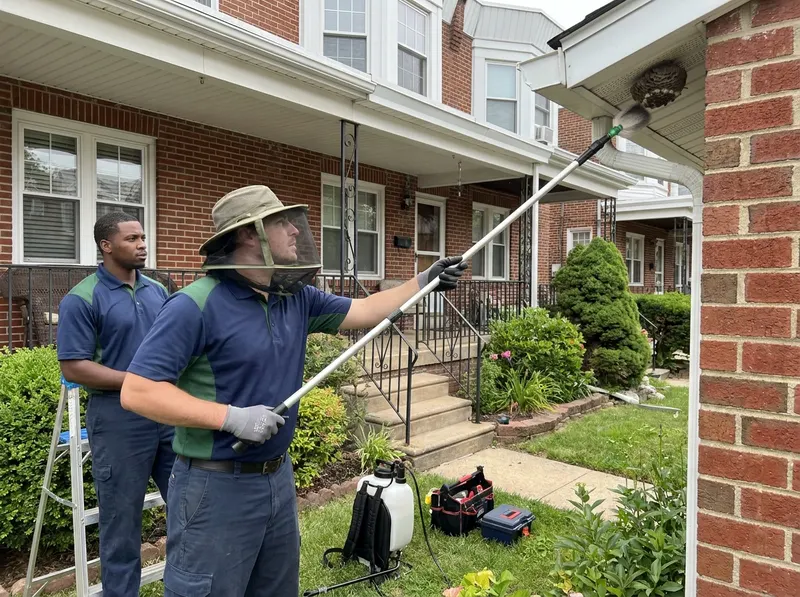
Stinging insect control in Philadelphia requires distinct treatment protocols based on whether an infestation occupies exposed eaves or concealed architectural voids. In dense rowhouse corridors throughout Passyunk Square, Fishtown, and South Philadelphia, German yellowjackets frequently exploit degraded brick mortar and unsealed utility penetrations, establishing large colonies inside double-wythe brick walls and drop ceilings. Conversely, properties bordering dense canopy zones near Wissahickon Valley Park and Fairmount Park in Chestnut Hill, Mount Airy, and Manayunk routinely encounter baldfaced hornets suspended 15 to 30 feet high in mature maples or attached to wood siding. Ground nests typically emerge in unpaved backyards, garden borders, and stone retaining walls across University City and Northern Liberties. Choosing direct nest removal over superficial over-the-counter surface sprays prevents stinging insects from retreating deeper into residential living spaces. DIY aerosol cans irritate aggressive social insects without saturating the brood core, often driving yellowjackets through baseboards or drywall seams directly into occupied bedrooms.
Effective management relies on species-specific integrated pest management protocols established by the EPA Integrated Pest Management Principles, combining precise chemical placement with physical harborage exclusion. Technicians evaluate the species, colony size, and structural risk before selecting between micro-encapsulated liquid barriers, directional insecticidal dusts, or high-reach mechanical poles. Application procedures comply with national standards defined by the National Pest Management Association, ensuring compounds remain isolated to the target nesting cavity without drifting into living quarters or non-target soil zones. If feral honeybees are identified rather than wasps or hornets, extermination halts to facilitate live honeybee relocation in accordance with guidelines from the USDA Animal and Plant Health Inspection Service and local apiary standards outlined by the Pennsylvania Department of Agriculture.
Structural void infestations involve a two-step process: active injection of residual formulations approved under the Federal Insecticide, Fungicide, and Rodenticide Act, followed by mechanical closure. Unlike open eaves where a nest can be cut down immediately, sealing an active void entrance prematurely forces trapped foragers to chew through interior sheetrock, leading to catastrophic indoor swarms. The trade-off between exterior knockdown and structural wall extraction involves recovery time: exposed nests offer immediate same-day resolution, whereas wall-void colonies require 48 to 72 hours for active foraging cycles to collapse before entry points can be permanently weather-sealed. Technicians adhere to ladder safety regulations set by the OSHA Ladder Safety Standard, deploying specialized extension ladders and fall-arrest harnesses to reach dormers and cornices on historic three-story structures near Rittenhouse Square and Kensington.
Long-term site defense integrates targeted non-chemical exclusionary repairs to prevent annual re-infestation. Queens emerge from winter diapause in late April, searching for uncaulked roof returns, unbacked soffit vents, and gaps around window casings. Installing corrosion-resistant copper mesh and structural silicone sealants along masonry edges blocks queen colonization before primary comb construction begins. Field applications prioritize the health and safety of family members and companion animals, aligning with protective standards established by the National Institute for Occupational Safety and Health and the ASPCA Animal Poison Control Center. Environmental stewardship protocols follow the conservation directives of the U.S. Fish and Wildlife Service, preventing runoff into adjacent storm drains and watersheds. Crestora Pest Defense executes every treatment with focused precision, resolving stinging insect pressures without pushing costly ongoing contracts or disruptive broadcast sprays. Contact the local team directly at (215) 252-5924 for property evaluations.
Every job gets a firm, written price after a free on-site visit.
For standards, safe disposal, and service guidance on PEST CONTROL SEVICE in Philadelphia, PA, useful references include U.S. EPA, ENERGY STAR, U.S. Dept. of Energy, Consumer.gov, U.S. Census Bureau, and Google Maps. General consumer and small-business resources are available from USA.gov, Better Business Bureau, FTC Consumer Advice, U.S. Small Business Administration, and Ready.gov.
Tell us about your stinging insect control job in Philadelphia and we'll send a clear, written quote, usually the same day.
 Crestora Pest Defense