Residential architectural characteristics across Philadelphia County establish prime harboring microclimates for diverse arachnid species. Historic fieldstone basements in Chestnut Hill and Mount Airy provide sustained…
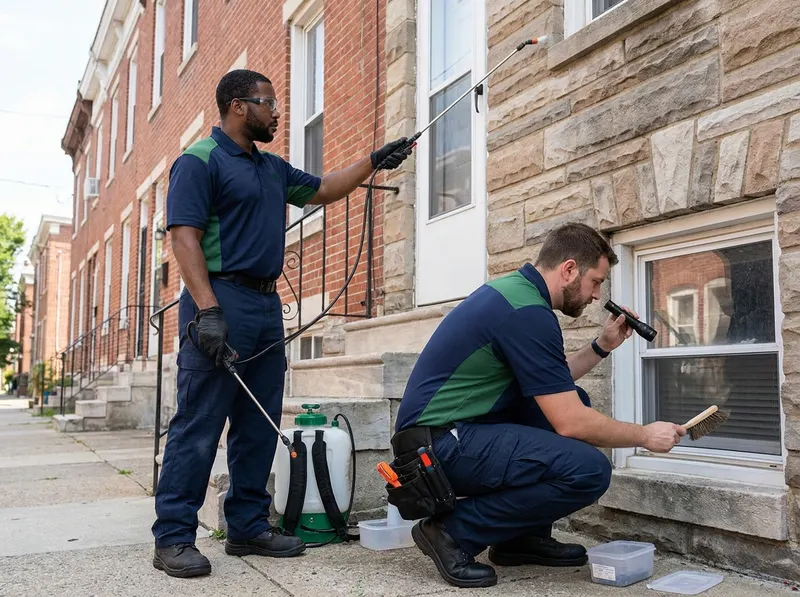
Residential architectural characteristics across Philadelphia County establish prime harboring microclimates for diverse arachnid species. Historic fieldstone basements in Chestnut Hill and Mount Airy provide sustained relative humidity exceeding 65%, creating ideal harborage for long-bodied cellar spiders and wolf spiders. Conversely, dense attached brick row homes lining Fishtown, Northern Liberties, and Passyunk Square often feature unsealed utility entry points, aging sill plates, and hollow masonry walls where yellow sac spiders establish diurnal silk resting sacs. Modern mid-rise apartments throughout University City and Rittenhouse Square frequently accumulate orb-weaver populations along exterior window banks and balcony soffits due to exterior architectural down-lighting attracting nocturnal flying insect vectors.
Effective arachnid mitigation requires adhering to the mechanical standards defined by the EPA Integrated Pest Management (IPM) guidelines. Spiders operate as opportunistic carnivores; their presence directly correlates with secondary insect populations such as fungus gnats, dermestid beetles, and midges. Eliminating web structures using continuous mechanical brushes removes egg sacs capable of yielding 100 to 300 spiderlings per cluster. Subsequent crack-and-crevice treatments utilize microencapsulated non-staining pyrethroids conforming to Pennsylvania Department of Agriculture pesticide regulations, engineered to penetrate resting zones without dispersing residues across open, human-occupied flooring.
Structural exclusion remains the definitive barrier separating short-term knockdown from lasting architectural protection. Field technicians implement physical barrier sealing around basement egress frames, deteriorated mortar channels, and plumbing penetrations using copper mesh and silicone sealants aligned with structural building protocols outlined by the Philadelphia Department of Licenses and Inspections. For multi-story properties along the elevated banks of Manayunk or mixed-use brick storefronts throughout Kensington and South Philadelphia, perimeter band applications extend 3 feet up the exterior masonry and 5 feet outward along the soil line, blocking entry routes commonly adjacent to vegetation managed under Penn State Extension entomology recommendations. Homeowners wishing to bypass synthetic indoor sprays benefit from targeted desiccant dust applications containing amorphous silica, which degrade the waxy lipid layer of arachnid exoskeletons while remaining inert for domestic environments according to the National Institute for Occupational Safety and Health chemical standards.
Comprehensive intervention balances non-repellent surface treatments with microclimate alteration. Basement dehumidification protocols calibrated alongside recommendations from the American National Standards Institute minimize baseline relative humidity below 50%, forcing moisture-dependent ground dwellers to vacate subterranean utility cavities. Property owners receive transparent diagnostic breakdowns rather than forced long-term subscription mandates, matching treatment boundaries directly to verified structural infestation densities verified through physical specimen collection.
Every job gets a firm, written price after a free on-site visit.
For standards, safe disposal, and service guidance on PEST CONTROL SEVICE in Philadelphia, PA, useful references include U.S. EPA, ENERGY STAR, U.S. Dept. of Energy, Consumer.gov, U.S. Census Bureau, and Google Maps. General consumer and small-business resources are available from USA.gov, Better Business Bureau, FTC Consumer Advice, U.S. Small Business Administration, and Ready.gov.
Tell us about your spider control job in Philadelphia and we'll send a clear, written quote, usually the same day.
 Crestora Pest Defense